I have become intrigued with the profusion of "Maker Culture" particularly in the last few years. There have always been people that enjoy making things, whether they were weekend wood-workers with a garage shop, or crafters with a spare bedroom full of bead bins. My grandmother probably produced several acres of knitting in her lifetime. But in the last few years, there seems to be a spreading interest in making all sorts of things. Some businesses, such as TechShop, have sprung up around this. Make Magazine offers fantastic ideas and articles for people. Likewise, the Maker Faire is a part science faire, part show-and-tell, part rave that is now appearing annually in at least three places in the country.
The cost of high-quality tools for making things has also been dropping, sometimes due to concerted development (such as machine tools) and sometimes due to very clever hacking (such as printed circuit board fabrication.)
Machine tools, even those aimed at "professional" shops, have come down in price dramatically in the last few decades. And some things that simply couldn't be done at all are now commonplace. I'm thinking of computer controlled fabrication tools. Mills that used to cost in the hundreds of thousands or tens of thousands of dollars are now in the thousands. Laser cutting / etching / engraving systems can now be purchased starting at a few thousand dollars. And the computing power, both embedded in these tools, and in the desktop computers that everyone has, provide almost unlimited control capabilities.
Printed Circuit Board (PCB) fabrication is something near and dear to my heart as well, because designing the circuitry that gets turned into PCBs has been one of my primary job functions for most of the last 15 years. The entire design flow goes something like this: Circuit Design -> Schematic Capture -> PCB Layout -> Fabrication.
Every step along this chain now is accessible, in some form, to the home amateur. There are design tools such as SPICE to computationally analyze the behavior of circuits. Schematic capture and layout tools are now available in free open source software such as KiCad and gEDA. And home fabrication can take advantage of technologies like ink-jet printing to print resist onto copper clad board with readily available consumer printers using a PCB starter kit from Full Spectrum Engineering. Of course, if you get as far as generating Gerber files (the standard graphical format for PCB artwork fabrication), you can just send your art out to a service bureau and have them professionally fabricated, often for less than $50 for small boards.
I realize as I write this that the field is so vast that it merits a much more detailed look at what can be done, and since this is "Weekend Engineering," clearly I need to do some projects and post some results... I'll try to include some original design work in upcoming posts. But for now, if you are interested in making things yourself, look around online because there is a community of like-minded people in whatever you want to explore. Some of the other categories of making that intrigue me:
- Silver-smithing
- Ammunition Loading (and even bullet casting)
- Home Video / DVD / BluRay production
- Do-It-Yourself Plastic fabrication
- Welding
- Robotics
And the list goes on and on and on and on... How about you? Leave a comment with what you like to make!
Thursday, October 7, 2010


Wednesday, October 6, 2010
Mobile Data Entry
i really like my motorola droid phone, but there are definite weaknesses... for example, the browser has various pathologies. as you can see, i cant seem to get capital letters or access the alt key functions for punctuation. the keys are also really close together, leading to about a five percent typo rate. but at least it works enough to write anything here at alll...
Tuesday, October 5, 2010
The Power of Sleep
Sleep is a wonderful thing. There have been various times when I have made a concerted effort to get enough each night, which for me is about 8 hours. When I'm sick, I am consistently amazed by how often I can feel better just by sleeping for 12 or 14 hours straight. And yet, even knowing that I feel better when I sleep enough, and it can cure many ills, I don't consistently get enough sleep. It is, I suspect, a problem of the delayed gratification of feeling generally good the whole next day, versus the immediate (perceived) reward of staying up late working on "things I want to do." Even though the things I often end up doing later at night are obviously, even as I do them, a giant waste of time.
Every person's sleep requirement is different. I have read that Albert Einstein needed 12 hours of sleep each night. Some of my friends claim to need only 4 or 5 hours sleep a night. I do tend to believe that almost everyone I know is chronically sleep deprived. And high school students are some of the worst of all. Research suggests that the developing brains of teens need about 9.5 hours of sleep each night, more even than 8 - 10 year olds. Instead, schedules overloaded with school, homework, sports, clubs, socializing, other extra curricular activities, and sometimes even jobs, lead to the zombie-like shuffle of chronic sleep deprivation. And it doesn't just make teens grumpy. Sleep deficit can result in increased chance of accidents, inhibited cognition, and diminished learning capacity.
Rotating shift work, such as the schedules used by many police departments, also results in extremely poor sleep hygiene. It can take weeks to shift your sleep schedule around when you change shifts, from days to evenings to graveyard, and about the time you finally settle into a new schedule, it's time to change again. It's like being continuously jet-lagged.
If you don't consistently get a good solid 8 hours of sleep a night, I challenge you to record how much sleep you DO get each night for a week. Then spend the next week making your very best effort to get to bed at the same time each night, and to sleep for at least 8 straight hours every night. You might be amazed how good it makes you feel. And before you point out how you can't afford the time, consider that the time you are awake, once you're well rested, will be MUCH more productive.
I'll try to get enough sleep as well myself... right after I take care of a few more things yet tonight...
Every person's sleep requirement is different. I have read that Albert Einstein needed 12 hours of sleep each night. Some of my friends claim to need only 4 or 5 hours sleep a night. I do tend to believe that almost everyone I know is chronically sleep deprived. And high school students are some of the worst of all. Research suggests that the developing brains of teens need about 9.5 hours of sleep each night, more even than 8 - 10 year olds. Instead, schedules overloaded with school, homework, sports, clubs, socializing, other extra curricular activities, and sometimes even jobs, lead to the zombie-like shuffle of chronic sleep deprivation. And it doesn't just make teens grumpy. Sleep deficit can result in increased chance of accidents, inhibited cognition, and diminished learning capacity.
Rotating shift work, such as the schedules used by many police departments, also results in extremely poor sleep hygiene. It can take weeks to shift your sleep schedule around when you change shifts, from days to evenings to graveyard, and about the time you finally settle into a new schedule, it's time to change again. It's like being continuously jet-lagged.
If you don't consistently get a good solid 8 hours of sleep a night, I challenge you to record how much sleep you DO get each night for a week. Then spend the next week making your very best effort to get to bed at the same time each night, and to sleep for at least 8 straight hours every night. You might be amazed how good it makes you feel. And before you point out how you can't afford the time, consider that the time you are awake, once you're well rested, will be MUCH more productive.
I'll try to get enough sleep as well myself... right after I take care of a few more things yet tonight...
Monday, October 4, 2010
Seeing Your Product In Stores
Walking down the aisle at Fry's the other day, I saw something that made me smile:
 This is Baseball Mogul 2010, the baseball simulation produced by Sports Mogul. Sports Mogul was created by two of my friends from the early-mid 90's, when I worked with briefly as a computer game programmer at Stormfront Studios. Clay and Dee Dreslough started the company following their time at Stormfront, wanting to take sports franchise simulation in a new direction. They have managed to keep the company alive for well over a decade now. This is a major accomplishment...
Anyway, the reason it made me happy to see Baseball Mogul in Fry's is because there is something immensely cool about seeing your product in a retail store. I have worked for a number of companies over the last 18 years, including:
- Amdahl, working on mainframe computers
- Stormfront Studios, working on computer games
- Alantec / FORE Systems / Riverstone Networks, working on network boxes
- NETSchools working on educational computers
- Leapfrog working on educational toys
- ShotSpotter working on gunshot location sensors
(And yes, I know that six of those eight companies have gone out of business or been absorbed by some other business. THAT is a topic for another entry someday...)
Only at Stormfront and Leapfrog did I experience the joy of seeing a product I worked on in stores for sale to the general public. If you ask most people that work on consumer products, I think you will find that they get a thrill out of seeing the fruit of their labor on sale in stores. It gives many of the seemingly abstract details of work a concrete reality. To quote the production credits for Chris Carter's 10/13 TV Productions, "I Made This!"

Anyway, the reason it made me happy to see Baseball Mogul in Fry's is because there is something immensely cool about seeing your product in a retail store. I have worked for a number of companies over the last 18 years, including:
- Amdahl, working on mainframe computers
- Stormfront Studios, working on computer games
- Alantec / FORE Systems / Riverstone Networks, working on network boxes
- NETSchools working on educational computers
- Leapfrog working on educational toys
- ShotSpotter working on gunshot location sensors
(And yes, I know that six of those eight companies have gone out of business or been absorbed by some other business. THAT is a topic for another entry someday...)
Only at Stormfront and Leapfrog did I experience the joy of seeing a product I worked on in stores for sale to the general public. If you ask most people that work on consumer products, I think you will find that they get a thrill out of seeing the fruit of their labor on sale in stores. It gives many of the seemingly abstract details of work a concrete reality. To quote the production credits for Chris Carter's 10/13 TV Productions, "I Made This!"
Sunday, October 3, 2010
Upgrading a MacBook Hard Drive
My daughter has a 13" MacBook that we got her at the start of high school. She is now in her Senior year, and the deal we have with her is that if she can keep this machine alive until next year, we'll get her a new computer as she heads off to college. She shoots a lot of photos, though, and keeping a large working set on her machine requires frequent swapping out to our home server. I finally decided this weekend that a relatively cheap and easy mid-life kicker for her computer would be a hard drive upgrade.
The MacBook originally came with a Seagate 160 GB, 5400 RPM SATA drive. This weekend, Fry's had the Seagate Momentus 500 GB, 7200 RPM SATA drive on sale for $69.99. Poking around a bit, I found this blog post that describes exactly what I wanted to do. Getting it all set up to back-up the drive really did take only a few minutes. And the Carbon Copy Cloner software really is great, free for download with a donation requested.
Once I had the new drive connected externally with a USB to SATA interface, it took about 5 hours to clone the 160 GB from the old drive to the new one. When I swapped the new drive into the housing in place of the old one, the machine booted right up with the OS completely intact. It was very straight forward, just like Mac stuff is supposed to be.
The one thing that was notable is a hierarchy of obscurity for the closures as you get into the machine. To open the battery compartment, you need a coin. To remove the door that covers the memory slots and the drive bay, you need a #0 (tiny) Philips head screwdriver. To swap the hard drive out of it's sheet-metal mounting bracket, you need a Torx T8 driver. That last one surprised me a little... Why did they go with the obscure Torx screw in stead of another Philips head? It's not enough to prevent swapping out the drive, just enough to make it inconvenient, unless you happen to have a set of Torx drivers at home.
My daughter is very happy with the 3X increase in drive capacity, and the 33% increase in rotation speed has also nicely improved the perceived speed of the machine. With a bit of good luck, this will take her through her AP Studio Art Photography program and the remaining 8 months of high school.
The MacBook originally came with a Seagate 160 GB, 5400 RPM SATA drive. This weekend, Fry's had the Seagate Momentus 500 GB, 7200 RPM SATA drive on sale for $69.99. Poking around a bit, I found this blog post that describes exactly what I wanted to do. Getting it all set up to back-up the drive really did take only a few minutes. And the Carbon Copy Cloner software really is great, free for download with a donation requested.
Once I had the new drive connected externally with a USB to SATA interface, it took about 5 hours to clone the 160 GB from the old drive to the new one. When I swapped the new drive into the housing in place of the old one, the machine booted right up with the OS completely intact. It was very straight forward, just like Mac stuff is supposed to be.
The one thing that was notable is a hierarchy of obscurity for the closures as you get into the machine. To open the battery compartment, you need a coin. To remove the door that covers the memory slots and the drive bay, you need a #0 (tiny) Philips head screwdriver. To swap the hard drive out of it's sheet-metal mounting bracket, you need a Torx T8 driver. That last one surprised me a little... Why did they go with the obscure Torx screw in stead of another Philips head? It's not enough to prevent swapping out the drive, just enough to make it inconvenient, unless you happen to have a set of Torx drivers at home.
My daughter is very happy with the 3X increase in drive capacity, and the 33% increase in rotation speed has also nicely improved the perceived speed of the machine. With a bit of good luck, this will take her through her AP Studio Art Photography program and the remaining 8 months of high school.
Saturday, October 2, 2010
Re-Capping A PC Motherboard
Another recent home project, in the category of things that made me unreasonably pleased with myself, was replacing two capacitors that had failed on the motherboard of my Shuttle SN68SG2 PC. I actually first wrote about this computer in the context of the number of restarts required while installing Windows XP. The machine is now 2 years old, and is my primary desktop PC at home. About a week and a half ago, I was working one night when it just clicked off. No warning, no shutdown, just >blink.< This is never a good sign.
After a moment of swearing, I realized that virtually all of the apps I use these days save automatically and so the actual risk of lost data was minimal. I powered back up, and everything worked fine, so I convinced myself that it was just some power glitch on the mains, and nothing to be particuarly worried about.
Two days later, it happened again. And this time I had to admit that it was probably a real problem, and I would have to at least keep an eye out for it. I powered back up, and went back to work... for about an hour. When I powered up following that third failure, I didn't quite get all the way through Windows booting before it dropped dead again. Once the mean time between failures of a PC is less than the boot time for Windows, it is pretty well shot.
Given the nature of the failure, I was almost certain that it must be the power supply. Nothing else, it seemed, was likely to cause such an instantaneous power-off failure like that. So I took the housing apart, measured the power supply, and figured out that there was a replacement available at Fry's. With the new power supply installed it came up, booted to my desktop... and then died. More swearing.
Finally I Googled around and came across this forum posting about my model. Sure enough, upon closer inspection, those same two capacitors in my machine were bulging badly:

When I removed them from the board, one of them also showed signs of electrolyte leakage on the bottom side:

Interestingly, when I measured the capacitance, both the failed caps actually measured *above* spec. The parameter that has gone bad, I suspect, is the equivalent series resistance. These are "ultra-low ESR" caps, meaning, essentially, that they store and release charge very efficiently. Or at least, they used to before their guts started leaking out. I don't have an ESR meter, but that is the usual failure mode. This is an example of the capacitor plague which dates back to the late 90's when some of the Chinese manufacturers got a bit sloppy with their electrolyte formulation. But since the parts only fail after several years of use, there are many millions of them in service.
Getting replacement parts was an interesting challenge. The original caps are 8 mm in diameter and 23mm long, with a capacitance of 1800uF, and a voltage rating of 6.3V. They were also nominally rated at about 0.015 ohms at 100KHz. I could have ordered from Mouser to get some almost exactly the same size and ESR, but it would have taken at least 2 days and cost $38 in shipping, for $2 worth of parts. The closest part I could find over the counter locally was at HSC Electronics Supply in Santa Clara, and they were 1800uF, 0.025 ohms at 100KHz, but rated at 25 volts. This meant they were appreciably larger:
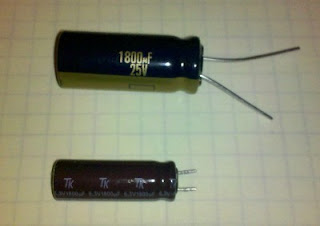
Even the leads on the new caps were larger, 0.2mm wider than the originals, so I had to grind them down with a Dremel tool, and bend them inward to make up for their wider spacing. Once installed, the new caps stood a bit off the board, but it was a situation of "close enough." The off-board mounting proved fortuitous, because their extra height also caused them to interfere with the heat pipe between the processor heat sink and the fan. I ended up bending them over slightly to fit the system back together.
So in the end it was not a particularly clean and elegant fix, but it worked, the parts cost $2, and I was able to get them locally. I put the machine all back together, and it booted right up. And when I came back about 20 minutes later, it was off again. (#$%@!) Then I realized that I'd forgotten to reconnect the power to the fan when I put it all back together, and the machine had shut itself off because it had overheated. I let it cool down, plugged in the fan, and it has now been running for about a week. I'm hopeful that I'll get a couple more years of use out of it before I need to replace it.
After a moment of swearing, I realized that virtually all of the apps I use these days save automatically and so the actual risk of lost data was minimal. I powered back up, and everything worked fine, so I convinced myself that it was just some power glitch on the mains, and nothing to be particuarly worried about.
Two days later, it happened again. And this time I had to admit that it was probably a real problem, and I would have to at least keep an eye out for it. I powered back up, and went back to work... for about an hour. When I powered up following that third failure, I didn't quite get all the way through Windows booting before it dropped dead again. Once the mean time between failures of a PC is less than the boot time for Windows, it is pretty well shot.
Given the nature of the failure, I was almost certain that it must be the power supply. Nothing else, it seemed, was likely to cause such an instantaneous power-off failure like that. So I took the housing apart, measured the power supply, and figured out that there was a replacement available at Fry's. With the new power supply installed it came up, booted to my desktop... and then died. More swearing.
Finally I Googled around and came across this forum posting about my model. Sure enough, upon closer inspection, those same two capacitors in my machine were bulging badly:

When I removed them from the board, one of them also showed signs of electrolyte leakage on the bottom side:

Interestingly, when I measured the capacitance, both the failed caps actually measured *above* spec. The parameter that has gone bad, I suspect, is the equivalent series resistance. These are "ultra-low ESR" caps, meaning, essentially, that they store and release charge very efficiently. Or at least, they used to before their guts started leaking out. I don't have an ESR meter, but that is the usual failure mode. This is an example of the capacitor plague which dates back to the late 90's when some of the Chinese manufacturers got a bit sloppy with their electrolyte formulation. But since the parts only fail after several years of use, there are many millions of them in service.
Getting replacement parts was an interesting challenge. The original caps are 8 mm in diameter and 23mm long, with a capacitance of 1800uF, and a voltage rating of 6.3V. They were also nominally rated at about 0.015 ohms at 100KHz. I could have ordered from Mouser to get some almost exactly the same size and ESR, but it would have taken at least 2 days and cost $38 in shipping, for $2 worth of parts. The closest part I could find over the counter locally was at HSC Electronics Supply in Santa Clara, and they were 1800uF, 0.025 ohms at 100KHz, but rated at 25 volts. This meant they were appreciably larger:

Even the leads on the new caps were larger, 0.2mm wider than the originals, so I had to grind them down with a Dremel tool, and bend them inward to make up for their wider spacing. Once installed, the new caps stood a bit off the board, but it was a situation of "close enough." The off-board mounting proved fortuitous, because their extra height also caused them to interfere with the heat pipe between the processor heat sink and the fan. I ended up bending them over slightly to fit the system back together.
So in the end it was not a particularly clean and elegant fix, but it worked, the parts cost $2, and I was able to get them locally. I put the machine all back together, and it booted right up. And when I came back about 20 minutes later, it was off again. (#$%@!) Then I realized that I'd forgotten to reconnect the power to the fan when I put it all back together, and the machine had shut itself off because it had overheated. I let it cool down, plugged in the fan, and it has now been running for about a week. I'm hopeful that I'll get a couple more years of use out of it before I need to replace it.
Melting Ice - Latent Heat of Fusion
One of the interesting experiments done in 8th grade physical science is a demonstration in which the temperature of a mixture of ice and water is measured, while it is being heated with a Bunsen burner or a hot-plate. Even though substantial energy is being put into the mixture of ice and water, the temperature stays fixed at (approximately) 0 degrees C. What changes, of course, is the amount of ice in the bath. Once all the ice has melted, then the temperature of the water begins to increase.
If you continue to heat it, the temperature of the water will increase in (almost) direct proportion to the amount of energy put into it, until it gets to (approximately) 100 degrees C. At 100 degrees C, the temperature will again hold steady, while the water boils, until it has been completely converted to steam.
The phase change from solid (ice) to liquid (water), and then to gas (steam) requires energy. That energy is well defined, too. The energy difference between liquid and solid is know as the "latent heat of fusion." In order to turn 1 kilogram of ice into 1 kilogram of water requires 333.55 kilojoules of energy.
Suppose you wanted to melt a column of ice 200 feet tall, and 10 feet in diameter. That would be a cylinder with a volume of pi * radius^2 * height = 3.14159 * 25 feet^2 * 200 feet = 15707.95 cubic feet, or (using Google to convert units) 444.8 cubic meters, or 444,800 liters. Ice has a density of about 0.9167 kg / liter, so we're trying to melt 407,748 kg of ice. This will require 407,748 * 333.55 kilojoules of energy, or 1.36 x 10^12 joules. 1 Joule per second is one Watt of Power, so if we were trying to melt this ice in, say 2 weeks = 336 hours = 1,209,600 seconds, we would need to continuously apply (assuming there were no other thermal inputs or outputs to our system) 1.36 x 10^12 joules / 1.2096 x 10^6 seconds = 1.124 x 10^6 watts, or about 1.1 megawatts.
Hmmm. That's a lot of energy to deliver, continuously, for two weeks straight, so it would be really hard to melt a column of ice 200 feet high and 10 feet across. Especially with a gallium arsenide laser. The motivation for this exercise is intentionally left cryptic. But I'm looking at you again, Dan Brown.
If you continue to heat it, the temperature of the water will increase in (almost) direct proportion to the amount of energy put into it, until it gets to (approximately) 100 degrees C. At 100 degrees C, the temperature will again hold steady, while the water boils, until it has been completely converted to steam.
The phase change from solid (ice) to liquid (water), and then to gas (steam) requires energy. That energy is well defined, too. The energy difference between liquid and solid is know as the "latent heat of fusion." In order to turn 1 kilogram of ice into 1 kilogram of water requires 333.55 kilojoules of energy.
Suppose you wanted to melt a column of ice 200 feet tall, and 10 feet in diameter. That would be a cylinder with a volume of pi * radius^2 * height = 3.14159 * 25 feet^2 * 200 feet = 15707.95 cubic feet, or (using Google to convert units) 444.8 cubic meters, or 444,800 liters. Ice has a density of about 0.9167 kg / liter, so we're trying to melt 407,748 kg of ice. This will require 407,748 * 333.55 kilojoules of energy, or 1.36 x 10^12 joules. 1 Joule per second is one Watt of Power, so if we were trying to melt this ice in, say 2 weeks = 336 hours = 1,209,600 seconds, we would need to continuously apply (assuming there were no other thermal inputs or outputs to our system) 1.36 x 10^12 joules / 1.2096 x 10^6 seconds = 1.124 x 10^6 watts, or about 1.1 megawatts.
Hmmm. That's a lot of energy to deliver, continuously, for two weeks straight, so it would be really hard to melt a column of ice 200 feet high and 10 feet across. Especially with a gallium arsenide laser. The motivation for this exercise is intentionally left cryptic. But I'm looking at you again, Dan Brown.
Subscribe to:
Posts (Atom)